In continuing our quest along the Thread of Europe, I focused on finding sections in the Balkans that would be well-suited to ski touring. It may seem far-fetched, but the watershed crosses numerous mountains in Bosnia, Montenegro, Albania, Kosovo, Serbia, and finally Bulgaria.
europesurlefil.com
I quickly ruled out Bosnia and Montenegro, as snow conditions are uncertain and the skiable mountains are quite far apart. Having already skied in Albania and Kosovo, I got back in touch with my local mountain guide, Gent, full of hope of finding a route along the steep mountains of northern Albania and Kosovo. But he quickly dissuaded me from doing it on skis: the steepness of the mountains, the complete lack of accommodation, even in the valleys in winter, the logistical complexities of resupplying, the unpredictable snow… In short, I had to abandon my hopes and will have to find a summer hiking route!
europesurlefil.com
My search had stalled. I nevertheless took a cautious look at the map of Bulgaria, and lo and behold, the Rila mountain range, practically on Sofia's watershed, seemed a possibility. For several years, agencies and guides had been offering ski trips in the Rila and Pirin mountains, but only as a single traverse or a series of day trips. Was it possible to roughly follow the Rila ridge from west to east? It seemed feasible, but the inaccurate maps, the Cyrillic names, and the questionable or seemingly closed accommodations raised complex questions. So, I began searching for a Bulgarian intermediary, a mountaineer who skied in these ranges during the winter.
europesurlefil.com
After countless emails and much searching, I finally found the perfect guide in Lubomir Popiordanov. Together, we were able to plan a theoretical 5-day trek along the Rila ridge, following the watershed. Accommodation is in mountain huts, cabins, and guesthouses, with one long and challenging stage in a remote area, but it should be manageable. Now all that's left is to try the adventure soon.
Next summer, we plan to resume our trek along the European watershed, initially attempting to link the Dolomites to the Julian Alps at the Slovenian border. This section is missing from our quest. The watershed makes a detour through the Tre Cime Dolomites before reaching the border between Italy and Austria. It then follows this border almost all the way to Slovenia. The Via Alpina, well-known to Tyroleans, more or less follows this line, but avoids the numerous via ferratas, which offer excellent climbs and the chance to add some remarkable peaks to our list of achievements.
Our route is therefore planned, knowing that the mountain huts allow us to travel relatively light, without underestimating the complex logistics during peak season. As a precaution, we will bring enough supplies to be self-sufficient if necessary.
Further afield, we already hiked for three days in the Julian Alps a few years ago, before having to cut our trip short due to torrential rain near the Slovenian border. We still have the crossing of the Triglav massif to do, which we might be able to complete if the weather remains favorable.
I also considered doing part of the route on skis, but along the Via Alpina, all the mountain huts are closed in winter, which makes the challenge difficult. For us, it's far away, not always snow-covered, and not very high… is it worth the risk, the complex logistics, to discover mountain ranges completely unknown to the French? I'm keeping an eye on it, but I'm not entirely convinced.
Throughout the hike and this route, it's easy to find alternative walking paths, a little further from the watershed. These always-available options also make it easier to convince some friends to join us on the adventure. We're off to find this trek, which is sure to be exceptional.
Attention all those who have already traveled sections of this route. We would appreciate any recent information.
After 25 years of working in tourism, you will find here a summary and reflections on the use of airplanes in relation to the ecological transition, a particularly divisive subject in all debates.
It is now proven that air travel is a major source of pollution, arguably the worst per passenger. Decarbonizing aviation is an absolutely essential research project. but very distant and totally uncertain.
In the ecological initiatives hub where I work, the majority of young people now refuse to fly. Personally, knowing the benefits and progress that air travel represents, in terms of intercultural and economic exchange, or simply irreplaceable information between people, I am in favor of a profound overhaul of our airplane usage, but not for its complete cessation.
The first action we should consider is to maximize the use of other modes of transportation (trains, electric cars) and limit our travel (video conferences, traveling less frequently and, if possible, for longer stays). Some socially responsible tour operators are starting to offer this kind of approach and are taking action to promote more carbon-neutral or longer trips. I participated in the creation of a map on this topic, which serves as a reference. ( https://cdn.helloasso.com/.../carte%20vip%20creative... )
This means that we must drastically limit our air travel, especially medium and long-haul flights.
If I were still at the helm of my tour operator group today, I would start by conducting a carbon footprint assessment of the companies. And I would certainly impose decarbonization targets aligned with the Paris Agreement, meaning a 50% reduction in the companies' carbon footprint within 10 years, or 5% per year. This would mean fewer long-haul trips (setting an annual quota that must not be exceeded) and compensating with more low-carbon trips, or, if that's unattainable in terms of corresponding revenue, pivoting towards other, less carbon-intensive activities. But I'm no longer "in business," even though I'm an active observer! The benefit is at least having a set of ideas and actions that I share with the SMEs where I sit on the management committees.
Regarding flights, there are many CO2 emissions calculators such as Myclimate, Bonpote, Good Planet Foundation, etc. For example, they provide an equivalent amount of CO2 released into the atmosphere for a round trip:
Paris Marrakech 1 tonne
Paris New York 2.5 tonnes
Paris Tahiti 6 tonnes.
Recent findings on contrails and the resulting radiative forcing suggest that the reality is more like double that. That is to say, a round trip to Polynesia would result in five times the annual carbon footprint of a French person (2 tons) by 2035 (Paris Agreement) to limit global warming to 1.5 to 2°C (not to mention biodiversity loss, the depletion of fossil fuels and minerals, and other related threats). Today, the trajectory is surely over 2°C, which already foreshadows a dangerous and unpredictable world for our grandchildren!
Many, including airlines, talk about carbon offsetting by planting trees. This is typically pure greenwashing, because the emissions from a flight go directly into the atmosphere and will be there for thousands of years, while planted trees will take 10 to 20 years to begin absorbing CO2 in a rather undetermined amount!
It's much more accurate to talk about a voluntary ecological contribution, similar to carbon credits for polluting companies, provided the price per ton of CO2 is fair (currently too low at around €6). Looking at the numerous articles on the subject, the price assessment I can offer today is around €25. For flights under 5 hours, this should be increased slightly, as takeoff and landing contribute significantly to emissions. In other words, for the example flights, the "acceptable" contributions are approximately:
Paris to Marrakech €25-30
Paris to New York €60
Paris to Tahiti €150
Moreover, it can be noted that the simple taxes not borne by kerosene (?) while they are borne by all other fossil fuels, would not lead us far from such an additional cost.
It would be wise for all companies and tour operators to offer such a quasi-mandatory contribution, but I'm probably dreaming!
Finally, there's the question of who should receive this contribution for those who make the individual and rational decision to participate in decarbonization efforts. Many organizations exist, but their actions are often not scientifically credible in terms of decarbonization and tend to focus more on development aid. Choosing organizations accredited by the French government is a minimum requirement. Personally, I would recommend two:
That's all for this topic, which ultimately few people know about. Unfortunately, reality will likely remind younger generations of this in the years to come.
I hope I have been clear and have succeeded in contributing a little to this essential and vital project for our society, of which tourism is an integral part.
"When I went to school, they asked me what I wanted to be when I grew up. I answered, 'Happy.' They told me I hadn't understood the question. I replied that they hadn't understood life."
In this dark year of Covid, lockdowns and their attendant misery and annoyance, I have often asked myself about the role of my mountain activities, and in particular climbing and mountaineering, in my balance.
I was recently on a beautiful route in the Aravis mountains, with masterfully sculpted rock. We overlooked Le Grand Bornand from above, weaving from slab to fluted ledge. Here, water has worn away the limestone like an artist, creating drops, Scalloped edges, rounded shapes that indicated a possible route. A few hikers passed by at the base. Cowbells in the distance. And the two of us, alone in the world, in the verticality. I was on a difficult section (for me), a 6b climb, slab climbing on friction, a few meters above the last bolt. I had one or two more moves to find before I could belay again. The potential fall of several meters frightened me, like any old mountaineer who has doubted the strength of pitons. I've pulled them out before, but even now, despite the brand-new bolt, I'm reluctant to fall. And that sloping slab where I could hit my head. The younger climbers don't hesitate to jump. Personally, I refuse this option, which I see as an affront! So I had to concentrate. A hold allowed me to rub the toes of my climbing shoes to maximize the rubber's grip. With my hands flat, I searched for the tiniest cracks, or rather the microscopic sloping surfaces, to place the tips of my slippers, hoping they would hold. Life at the tips of my toes. Many would cry out at the absurdity of the situation. What an idea to get myself into such a predicament!
The concept of deliberate and controlled risk is part of the very essence of climbing. In 2021, bad news is piling up for the world and for us. So why not simply accept the onslaught of chance, without adding to it? Yet it is in these tense moments that I feel even more strongly the need to confront these mountain absurdities. Unlike the virus that has befallen us. Unlike serious illness, which is always with others, except this time. Unlike the car accident that awaits us on our return. In all these cases, we try to cope and adapt, trusting in the remedies provided by humanity: vaccines, treatments, airbags... But alone, facing myself on my slab, I release all the misfortunes below. I concentrate; I know and I feel that I will hold. My balance depends on nothing, but as much on the rubber of my climbing shoes as on my determination. A simple pendulum swing, then another, and another. Without holding my breath, my mind clear, I forget everything and simply enjoy this oft-repeated choreography. And at the end, I clip the bolt generously placed by this brilliant lead climber. A wave of happiness washes over me. Right here, right now, nothing was by chance. My life is here, held in my hands. In this brief moment, I've let go of all my sorrows and worries. I just feel good. I glance at Monique, who's belaying me. The bond of trust between us is natural, almost osmotic. The space around us is breathtaking. I want to shout my joy of living. How can I explain to others this feeling of exhilarating happiness, serenity, and a "reset" that a few vertical dance movements provide?
In the mountains, it's difficult to remain below the "equilibrium of chance." This is the breaking point where acceptable and controlled risk gives way to uncertain chance. There's the inherent element of chance, like the one we take every time we get into a vehicle. In mountaineering, this must be accepted: rockfall, avalanche, unexpected storm... But beyond that, it's different and dangerous to pass under a serac, to set out on skis the day after a heavy, windy snowfall, to tempt fate in threatening weather, to choose a route "a notch above one's current abilities"... At high altitude, it's difficult to turn back when, after so much effort, at the last camp, you have to turn around. Where is the limit? Great mountaineers are audacious, often too audacious. I still admire the likes of Rébuffat and Desmaison, who shaped my youthful dreams. I admire Messner, Bonatti, and Profit, who managed to dodge bullets and stop just in time. But when you're constrained by cameras, sponsors, a complex Himalayan peak, or your own inner demons, it's easy to cross one crevasse too many. Solo climbing remains, for me, bordering on suicidal. I don't like the way the media promotes it, even though I respect those who practice it. The mountains aren't about that; they're so much more. In solo climbing, there's an element of peril that you can never control: the hold that breaks, the falling rock, the sudden fainting spell. I've lost far too many friends who felt invincible, highly talented climbers who, in fact, were unwell. My rare solo climbs or extreme commitments were to follow companions, without daring to say no. Youthful mistakes and lucky breaks. Life is already burdened far too often with malevolent chance.
Climbing allows us to experience and relive those unique, intense moments where the rope team takes on its full meaning, where the movements of climbing allow life to perform a pirouette in the face of a fall. Everyone can also find their own outlet in confronting nature or in sport, thankfully. Our other mountain activities, like ski touring, mountain biking, and trekking, give us time to think while we're doing it. And that's extremely creative and recreational. But climbing has this unique quality of forcing us to stop thinking, to clear our minds in order to grasp and ascend a step, a cliff, or an immense wall. High-altitude mountaineering, which I practice less often these days, is the adventurous and extended version of this same quest. The beauty of the mountains, what needs to be shown in the media, is right there. No need for feats bordering on the morbid. Adventure is managed and compels us.
There. I've just crossed the threshold. The route continues. My feet ache in my new climbing shoes. My arms ache from lack of training. I feel the weight of the years too. But the pitches keep coming. We make our way together through this vertiginous stone desert. Trusting each other, confident in our experience. It doesn't matter which summit ends here when the rock no longer holds any interest. A kiss at the very top. A shared snack. And then we plunge down via long rappels into the void. Back to life? Or simply back to terra firma after having willingly brushed against paradise?
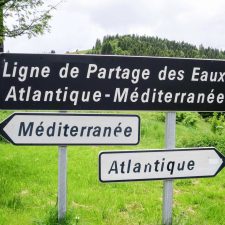
European waters flow into the Mediterranean to the south, and into the Atlantic, Arctic, and Black Seas to the north. This watershed runs from Tarifa in Andalusia to Istanbul in Turkey. It is a natural thread that has pushed springs and villages to its banks. We envisioned following it as closely as possible, adapting our activities to the terrain: mountain biking, hiking, skiing, and mountaineering. It is this wealth of experiences, routes, and journeys that we wish to share through this website.
Frederic Faure on Who are we ?: “This link is valid for 48 hours. I'm currently traveling and can't send you the GPX files right now. I hope…” June 15, 08:55
Estelle on Who are we ?: “Hello, I would like to see the GXP traffic for the Diagonale du Vide 2. Thank you in advance for sharing. Sincerely, Estelle” Jun 15, 08:49
Frederic Faure on The watershed: “Hello, I no longer have the map I used to find the best paths closest to the line…” Feb 6, 10:42
Jean-François KRAFT on The watershed: “Hello, I am contacting you because I am looking for a map of France with the precise outlines of the lines…” Feb 5, 15:56


Recent comments